

On this page you will find information about this theory and resources that can be used to test predictions arising from the theory.
The Memory and Identity Theory of ICD-11 CPTSD (M&I Theory) states that single and multiple trauma exposure occur in a context of individual vulnerability which interact to give rise to intrusive, sensation-based traumatic memories and negative identities which, together, produce the PTSD and DSO symptoms that define ICD-11 CPTSD.
The model emphasizes that the two major and related causal processes of intrusive memories and negative identities exist on a continuum from prereflective experience to full self-awareness.
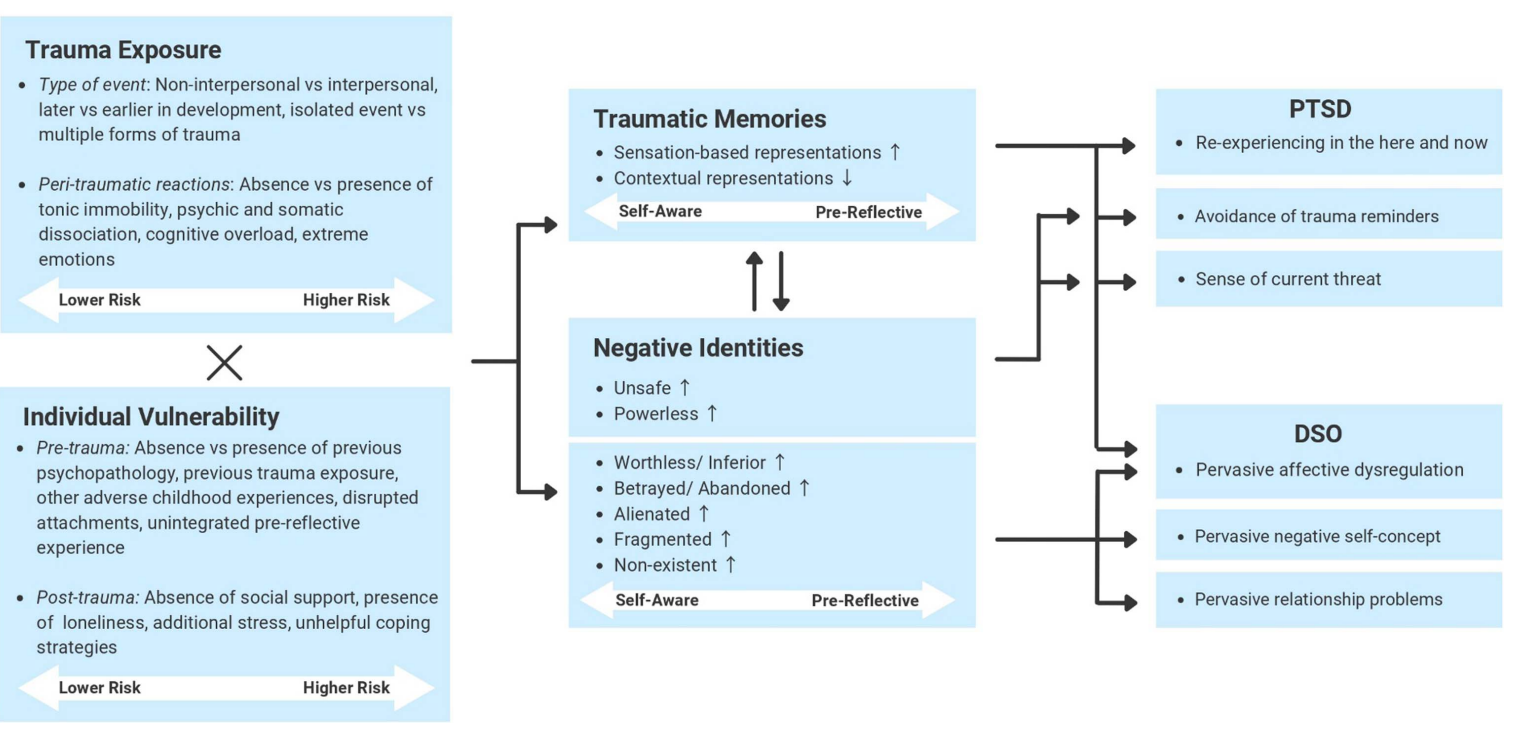
We have developed several measures to enable theory testing. The key theoretical variables are traumatic memories and negative identities. Another key element of the theory is pre-reflective experiences.
.png)
The International Trauma Questionnaire (ITQ) is a brief, simply worded measure, focusing only on the core features of PTSD and CPTSD - consistent with the organizing principles of the ICD-11, as set forth by the World Health Organization.
.png)
The International Trauma Exposure Measure (ITEM) is a checklist developed to measure exposure to traumatic life events in a manner consistent with the definition of trauma exposure in the 11th version of the International Classification of Diseases.
.png)
The Experiences of Traumatic Memories Questionnaire (ETMQ), the Trauma Identity Questionnaire (TIQ), and the Pre-Reflective Experiences Questionnaire (PREQ) all measure this construct in different ways